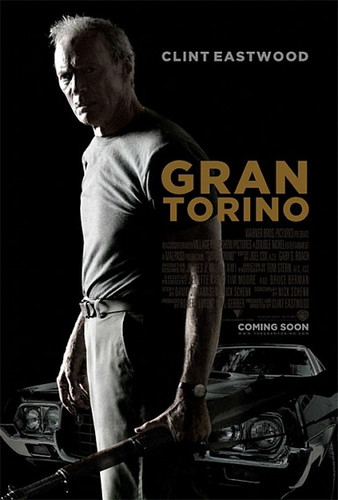
I saw Gran Torino tonight, the acclaimed new film directed and produced by Clint Eastwood. The story is about a retired and widowed Detroit auto man who angrily watches his neighborhood (and the world) turn into something he hates, but who might find redemption in the relationship he forges with the Hmong family next door.
You want the even shorter version? Dirty Harry as an old retired guy. Eastwood spends about 90 minutes wearing the facial expression he wore when he delivered the "Do you feel lucky, punk?" line in Dirty Harry. He's also got guns. Lots of guns. In the same way that Unforgiven felt like a late-in-life deconstruction of the western "hero" Eastwood had played again and again (in various roles and incarnations), Walt Kowalski in Gran Torino feels like the geezer version of every cop role Clint played (whether it was Dirty Harry or the guy in The Gauntlet.) On the way home, I was wondering if Million Dollar Baby matched up as a tribute to some series of roles he played. Could Hillary Swank have been a stand-in for the baboon in all those Whatever Which Whoozy Whatsit movies he did? (I know. It was an orangutan. But baboon is funnier. Try it.)
Eastwood once again portrays a faithless man in a dialogue with an annoying young priest (as he did in Million Dollar Baby). The priest in Gran Torino has about as much gravitas as Skippy from Family Ties. Upon finding him at his door soon after his wife's funeral, Walt tells the padre that "You hold the hands of superstitious women and tell them they're going to be all right in eternity," or similar words. Throughout the film, Walt struggles with his need for forgiveness for is Korean War wrongs. One wonders if Eastwood is dealing with some of his own "sins past" as he returns to these characters of old, faithless men who seem compelled by a force to do Something Good.
New ground for Eastwood (at least Eastwood of late) is the racial prejudice (replaced by brotherhood) in the movie. Walt drops bombs right and left that drew snickers from the audience, but which are blatantly unaccepted in today's society. In one memorable scene, he takes on a band of three black youths, stereotypical in their aggression and lawlessness. And the film has no postive black characters to balance this out, as is usually the practice. Walt ends up befriending the Hmong family nextdoor, and becomes almost a father figure to youg Tao (who he calls "Toad."). The Hmong are ethnically Asian, refugees from the various conflicts in Indochina and the Vietnam War.
The movie had lots of sincere laughs, and some stirring dramatic strokes. Howeve, it was poorly acted by almost everyone but Clint. And, despite the cynical nature of the character Clint plays, the film ends up being a bit cloying and sentimental. It felt a little bit like one of the "After School Specials" of my youth. I knew where it was going and there weren't many surprises.
Cool movie though. Clint Eastwood might be the greatest filmmaker of this era.

No comments:
Post a Comment